Dear Friends,
Over the years, many of you have asked for guidance on how to navigate Tsoknyi Rinpoche’s teachings on Fully Being and Nature of Mind as a path of practice. Students have also expressed a sincere wish to learn practices from Rinpoche’s Vajrayana lineages, taught with his distinctive flavor.
In response to these heartfelt requests, Rinpoche has clarified his vision for the student path. Beginning in 2027, this will shape both the structure of our retreats and the preparation and practice commitments expected of students. These changes reflect Rinpoche’s love and care for us and his wish that each of us taste the fruits of this profound path.
“Whatever my students practice and cultivate,
I want them to have essence love and rigpa.”-Tsoknyi Rinpoche
- Essence love is the heart of healing, rediscovered through the practices of Fully Being.
- Rigpa is the heart of liberation, recognized through the teachings on the Nature of Mind.
Recently, Rinpoche expressed his wish that his students also practice skillful means. Beginning in 2027, he will gradually offer some from his Vajrayana lineages. Skillful means help us gather merit and purify obscurations, and bring forth the fullness of the path and result of the three kayas of awakening.
Given this, we can think of essence love, rigpa and skillful means as the core aspects of Rinpoche’s student path.
Rinpoche’s Vision for the Path
Essence Love – the heart of healing – through the Fully Being teachings
The practices of Fully Being help us to become healthy human beings by reconnecting with groundedness, essence love, natural clarity and the mere I. Particularly, inner healing occurs as we rediscover our basic okayness, a natural wellbeing which Rinpoche calls essence love. Reconnecting with and nurturing this secure home of the feeling world is the foundation for a healthy and happy life, and also a stable basis for the path of liberation.
Rigpa – the wisdom heart of liberation – through the nature of mind teachings of Dzogchen and Mahamudra
These teachings point to direct recognition of rigpa, which is the underlying nature of mind. Through recognizing rigpa, developing its strength, and reaching stability, we can attain the dharmakaya—the formless aspect of enlightenment. This accomplishes our own benefit of freedom from hope and fear.
Skillful means – the method aspect – which purifies obscurations and gathers merit
As the dharmakya is formless, other beings cannot see our dharmakya . To bring lasting benefit to others, the form kayas are necessary. While the three kayas are inseparable in nature, various skillful means, particularly from Vajrayana, help bring forth accomplishment of the form kayas—sambhogakaya and nirmanakaya—which carry out the benefit of others.
What’s new: Retreat structure
The revised retreat structure is intended to support integration of the core aspects of Rinpoche’s path: essence love, rigpa, and skillful means. These are presented in our four new retreat categories:
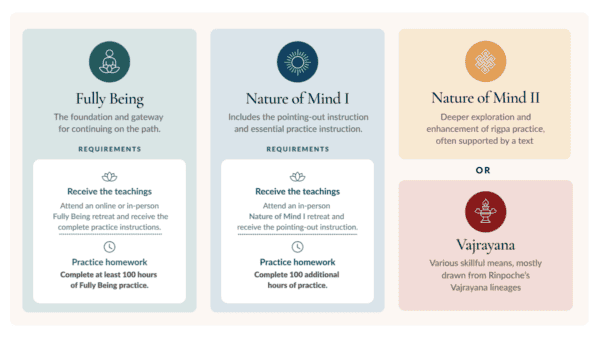
- Fully Being: A thorough presentation of the Fully Being practices
- Nature of Mind I: Direct introduction to rigpa (pointing-out the nature of mind), along with essential points of meditation and conduct
- Nature of Mind II: Deeper exploration and enhancement of rigpa practice, often supported by a text
- Vajrayana: Various skillful means, mostly drawn from Rinpoche’s Vajrayana lineages
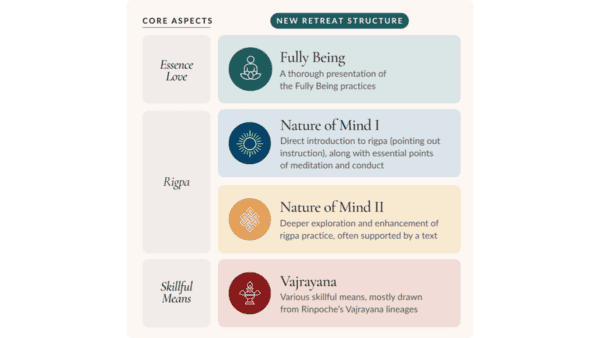
By offering retreats in these four categories, students can learn and practice each stage of the path in a focused way and at the appropriate time.
What’s new: Prerequisites and Practice Homework
Beginning in 2027, prerequisites and practice homework will be introduced. The first step of this path is to attend a Fully Being retreat, either in person or online, followed by a minimum of 100 hours of Fully Being practice. The next step is to attend an in-person Nature of Mind I retreat, followed by at least 100 more hours of practice. At that point, you may join any program you wish, including Nature of Mind II or Vajrayana retreats.
The principal reason for introducing prerequisites is to encourage students to internalize and integrate Rinpoche’s teachings at each stage of the path. Rinpoche often emphasizes: “Real transformation happens at the level of feeling,” and “A sign of progress is when your subtle body starts to experience rigpa.”
The practice homework reflects Rinpoche’s love for us and his wish to support our progress and discipline on the path. It helps us to familiarize ourselves with the teachings and connect the meaning to all aspects of our being, including our subtle bodies. It also helps us honor the depth and subtlety of Rinpoche’s path, as well as his heartfelt wish for us to absorb his teachings in a way that is transformative.
I’ve been attending retreats and practicing for years. How does this affect me? Read question #1 in the FAQ below.
What’s new: More retreats, shorter retreats
Retreats will now be three to five days long instead of six days, as in the past. This change will allow us to offer the four new retreat categories in place of the previous ‘Open’ and ‘Advanced’ retreats. We will also be able to offer more retreats each year, helping Rinpoche to reach more students. For example:
- At Garrison Institute in New York, we plan to offer two retreats (previously one).
- At Yeshe Rangsal Retreat Land in Crestone, we plan to offer three retreats (previously two).
Rinpoche will select from the new retreat categories based on the needs of the community. We will share details about the 2027 Garrison and Crestone retreats soon.
Looking Ahead
These changes are intended to bring our retreat offerings into closer alignment with the way Rinpoche teaches and guides students. As our community grows, greater clarity, structure, and continuity will help students engage more fully with each stage of the path and create the necessary conditions for genuine transformation.
We are grateful for the sincerity and commitment you bring to Rinpoche’s teachings, and we hope this revised format will help each of us deepen our practice over time. We will share additional details, including specific retreat dates and registration information, as the 2027 schedule is finalized.
FAQs
**Please read this before reaching out with questions. **
1. I’ve attended an Open retreat, received pointing-out instructions, and practiced for years. How does this affect me?
We honor your long-term commitment to Rinpoche and his teachings. Practice homework sets our intention to fully familiarize ourselves with the teachings and more directly experience the depth and subtlety of this path. Out of Rinpoche’s love for us and his care for our progress, he has offered more discipline.
Past attendance of a full Open retreat counts as having received both the Fully Being teachings and pointing-out transmission. Although we sincerely encourage repeatedly receiving these teachings, it is your choice whether to do so.
If you’ve been practicing Fully Being and Nature of Mind for years but have doubts about your familiarity with their key points—or whether you’ve tasted some of the results of these practices—please recommit to at least 100 hours of practice of either or both.”
2. What if I never attended an Open retreat but have come to several Advanced retreats?
The former prerequisites for Advanced retreats were very inclusive, requiring only that a student confirm they have received the pointing-out instructions from a qualified Dzogchen or Vajrayana master. Now that Rinpoche has clarified the core aspects of his path, he requests that you attend a Fully Being program and a Nature of Mind I program and complete the practice homework for each.
This request is designed to support your practice. Please attend a Fully Being program, either online or in person, and complete the homework. Then attend an in-person Nature of Mind I program, receive the pointing-out instructions, and complete the homework for that as well. Then you may attend any subsequent Nature of Mind II or Vajrayana programs.
3. What counts toward the practice hours?
In general, studying, contemplating and meditating are all part of the larger process of absorbing teachings. While we encourage all of these, only time spent in formal meditation practice counts towards the 100 hours.
4. How will I communicate completion of the practice homework?
During the registration process for each retreat, all students will be asked if they have completed the homework. It is an honor system; you will simply affirm that you have completed it. You are responsible for tracking your own practice hours.
5. Why 100 hours of practice?
Real transformation takes time. Recent scientific research has found that it takes an average of 66 days of repetition to form a new habit. Simple tasks (like drinking a glass of water) take less time; complex tasks (like a gym routine) take much longer. As the teachings and practices of Rinpoche’s path are profound and subtle, 100 hours could be considered a minimum amount of practice time to habituate our minds, bodies and subtle bodies.
6. Will Fully Being be in person or online?
Fully Being retreats will be offered both in person and online. If you receive the Fully Being teachings in an official online or in-person program, it qualifies as having received the teachings.
7. What is the difference between Nature of Mind I and Nature of Mind II?
Nature of Mind I retreats will include an introduction to the view, meditation and conduct of rigpa practice (which includes the pointing-out instruction). Nature of Mind II retreats will help those already practicing nature of mind to deepen and enhance their experience of rigpa.
8. Can I attend Vajrayana retreats without completing Nature of Mind II?
Yes. Once you have satisfied the Fully Being and Nature of Mind I prerequisites, both Nature of Mind II and Vajrayana retreats are available. You can attend both or either one and in any order.
9. What Vajrayana topics will Rinpoche teach on?
These are not yet decided and will be at Rinpoche’s discretion. There are many skillful means in the Vajrayana tradition that Rinpoche may choose to draw from, such as ngöndro (preliminary practices), creation stage practice of deity yoga, completion stage practices, bodhicitta, and guru yoga.
10. Is Rinpoche asking his students to engage with Vajrayana practices?
Rinpoche encourages us to engage with skillful means, including Vajrayana practices, but does not require us to do so. Skillful means, whether of Mahayana or Vajrayana, help us gather merit and purify obscurations. In addition to Vajrayana practices, there are other skillful means such as mind training, shamata and vipassana. Each student has their own personality and interests, and will be attracted to and motivated towards different skillful means. It is up to each of us to decide which of these practices to engage with.
11. Why Vajrayana, specifically?
As the dharmakaya is formless, other beings cannot see our dharmakaya. In order to bring lasting benefit to others, the form kayas are necessary. While the three kayas are inseparable in nature, the various skillful means of Vajrayana particularly help bring forth accomplishment of the form kayas—sambhogakaya and nirmanakaya—which carry out the benefit of others.
12. When will Rinpoche talk about how students who want to engage with the Vajrayana should approach it?
Rinpoche will offer this guidance for the first time during the teaching event at Tsoknyi Gechak Ling in Oct/Nov 2026. We will record this guidance and anticipate publishing it for the community as soon as we reasonably can.